
26, May 2026
7-minute read

Positioned between matric and a full degree, NQF Level 5 IT qualifications are South Africa’s most underrated entry point into a high-demand, high-earning tech career and more doors are opening in 2026 than ever before.
There is a persistent myth in South Africa’s education landscape that a university degree is the only credible path into a professional IT career. For a long time, that myth cost thousands of talented South Africans their shot at the technology sector. The reality in 2026 looks very different.
NQF Level 5 IT qualifications are nationally accredited, employer-recognised, and designed specifically to produce work-ready technical professionals. They sit above matric, equivalent in complexity to the first year of a bachelor’s degree, and they open genuine career pathways in systems development, cybersecurity, IT support, and networking. For anyone who has a Grade 12 certificate and wants to build a tech career without the time or cost of a full degree, they are one of the most strategically valuable options available in South Africa right now.
This guide covers everything you need to know: what NQF Level 5 actually means, which IT qualifications are available, how to access them, what they pay, and where they can take your career.
What NQF Level 5 actually means
The National Qualifications Framework (NQF) is South Africa’s unified system for classifying and recognising qualifications across all education and training sectors. Managed by SAQA, the South African Qualifications Authority, it spans ten levels, from Grade 9 equivalency at Level 1 to doctoral degrees at Level 10.
NQF Level 5 sits in the second band of the framework, the band that covers college diplomas and technical qualifications, spanning Levels 5 to 7. A Level 5 qualification is formally equivalent to a Higher Certificate, representing a depth of knowledge and applied competence that goes meaningfully beyond what matric or an NQF Level 4 vocational certificate can offer.
In practical terms, an NQF Level 5 IT qualification means a learner can work independently in a structured environment, apply technical knowledge to solve real problems, and demonstrate competence that employers in the ICT sector directly recognise. It is also an articulation point a formal stepping stone to Level 6 diplomas and, from there, to degree-level study if the learner chooses to continue.
The qualifications: what’s available in IT
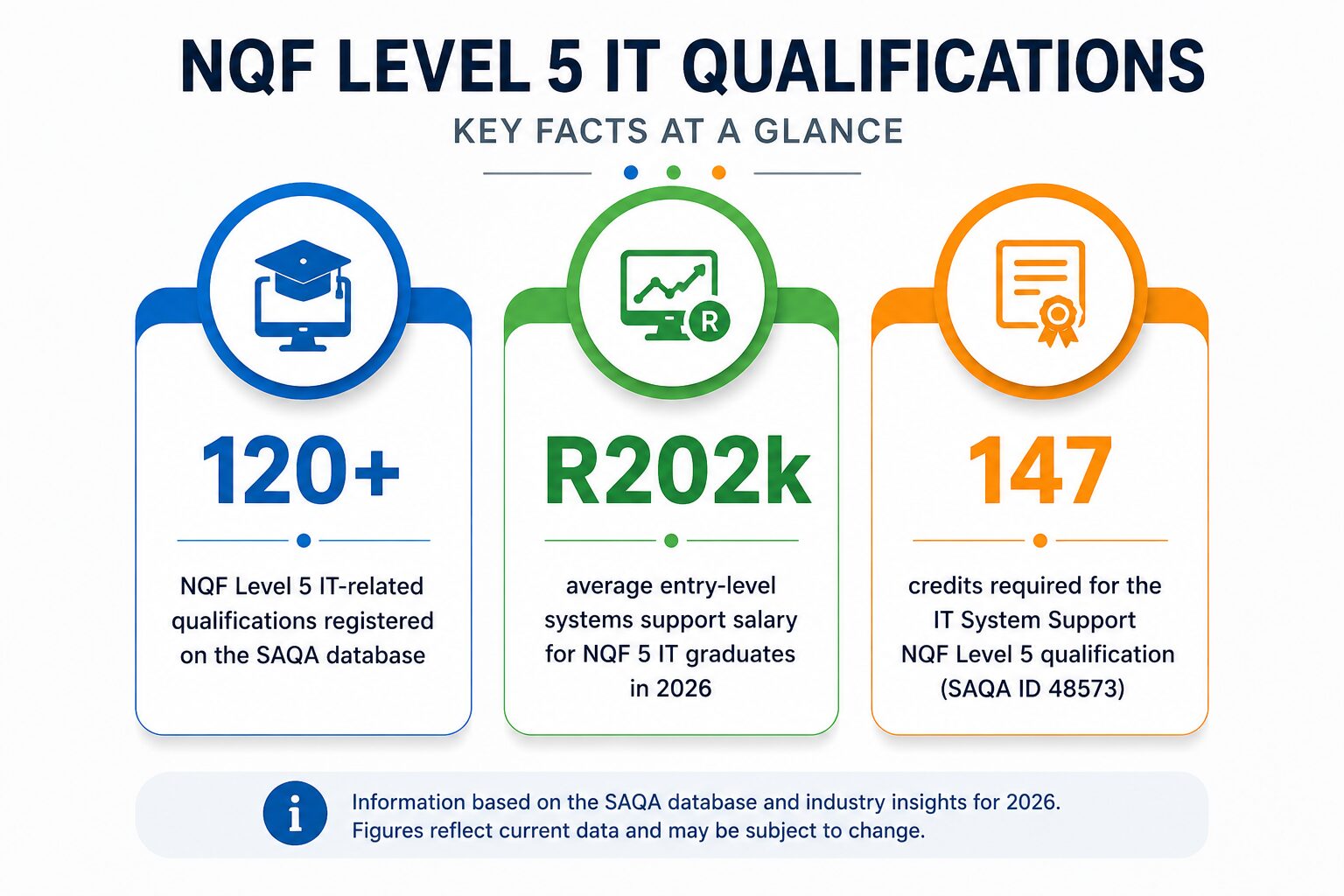
The SAQA database lists more than 120 NQF Level 5 qualifications with an IT or ICT component. The most widely enrolled and employer-recognised programmes in 2026 fall into four core specialisations:

Each of these qualifications is registered on the SAQA qualifications database, which means you can verify any programme’s legitimacy, accreditation status, and credit value before enrolling. This is important every legitimate South African qualification carries a unique SAQA ID, and checking it takes less than two minutes. Any provider unable or unwilling to supply their SAQA ID is a red flag.
Who these qualifications are designed for
The entry requirement for all NQF Level 5 IT programmes is a Grade 12 National Senior Certificate or an equivalent NQF Level 4 qualification. Recognition of Prior Learning (RPL) also offers a route for candidates who have significant relevant work experience but no formal qualification a particularly important pathway for the many South Africans who have built practical IT skills informally but never had the opportunity to have them credentialled.
These qualifications are well suited to school leavers entering the workforce for the first time, working adults looking to formalise their experience and move into more senior roles, career changers pivoting into the technology sector, and public sector employees whose departments are investing in digital capability. The range of delivery formats full-time, part-time, online, and learnership-based means most working schedules can be accommodated.
The learnership route: earn while you learn
The MICT SETA IT Learnership 2026 is one of the most accessible pathways to an NQF Level 5 IT qualification for unemployed South Africans. Funded through the Skills Development Levy, it is a 12-month programme combining structured classroom learning with practical workplace experience. Participants earn a monthly stipend of between R2,500 and R6,500 while studying removing the financial barrier that keeps many South Africans out of formal training.
The programme covers multiple specialisations including technical support, systems development, cybersecurity, telecommunications, and data science. Learners graduate with an NQF-accredited qualification and critically documented workplace experience that employers can verify. In a sector where employers consistently cite the lack of practical experience as a hiring barrier, this is a significant advantage over purely classroom-based study.
For employers, the learnership route also carries direct financial benefits: the cost of hosting a MICT SETA learner qualifies for SETA mandatory grant rebates and B-BBEE Skills Development expenditure recognition, making NQF Level 5 IT learnerships one of the more tax-efficient training investments available in the current regulatory environment.
Career outcomes and salary expectations
The South African ICT sector is one of the country’s fastest-growing employment markets. Technology is now embedded across every industry banking, healthcare, education, retail, and government and the demand for qualified IT professionals consistently outpaces supply. NQF Level 5 graduates enter a market that is, structurally, in their favour.

Beyond the entry-level positions, an NQF Level 5 qualification creates a clear articulation pathway to further study. Graduates can progress to NQF Level 6 diplomas in IT, advanced cybersecurity programmes, or with additional credits into degree-level study at a university or private higher education institution. The NQF’s articulation design ensures that credits earned at Level 5 are formally recognised in the academic progression system, meaning no learning is wasted.
How to choose the right programme
Five things to verify before you enrol
- Confirm the SAQA ID.Search the qualification on saqa.org.za. A registered qualification will show its NQF level, credit value, accrediting body, and registration end date. If it is not listed or the registration has expired, do not enrol.
- Check provider accreditation.The training provider must hold current MICT SETA or QCTO accreditation for the specific qualification being offered not just a general registration. Ask for their accreditation scope document.
- Understand the delivery format.Full-time, part-time, online, and blended options exist. Make sure the format is genuinely compatible with your work and life commitments an incomplete qualification has no value.
- Ask about workplace experience.QCTO occupational qualifications require a formal work component. Confirm whether the provider has employer partnerships in place, or whether you need to arrange your own placement.
- Clarify articulation pathways.Ask the provider which Level 6 or higher qualifications your Level 5 certificate gives you access to. A reputable provider will have clear answers and formal articulation agreements with receiving institutions.
The bigger opportunity
South Africa’s digital economy is not waiting. The demand for skilled IT professionals from systems support technicians to cybersecurity analysts to junior developers is growing faster than the country’s universities can produce graduates. NQF Level 5 qualifications exist precisely to fill that gap: structured, quality-assured, employer-recognised, and accessible to anyone who has completed matric.
For individuals, they represent one of the fastest, most affordable routes into a career with genuine earning potential and long-term growth. For employers, they are a pipeline of work-ready candidates who bring both theoretical grounding and practical experience. And for South Africa’s digital economy, they are part of the infrastructure that makes a technology-capable workforce possible one qualified professional at a time.
The path into tech does not have to start with a four-year degree and a student loan. In 2026, it can start with a verified qualification, a MICT SETA learnership, and the decision to begin.

Suprise Fakude
SEO Content Specialist
Suprise Fakude holds a Marketing degree from the Vaal University of Technology and specialises in SEO-driven content creation. Suprise focuses on producing content that not only ranks but also resonates, connecting learners with practical opportunities to upskill and thrive in South Africa’s changing world of work.